 |
| LIS 6010: LIS Leader Paper on Everett Thomson Moore |
Since beginning my studies in the School of Library and Information Science (SLIS) in the spring of 2010, I have experienced much growth and development as an information professional. Through my tenure as a MLIS candidate, I have mastered the competencies as outlined in the program’s ten learning outcomes and found selecting just three to elaborate upon considerably challenging; therefore, the three outcomes in which I selected, to demonstrate my proficiency, are very near and dear to my heart as well as align with my studies of concentration, public libraries and services to children and young adults. They are as follows: “[to] articulate the importance and value of the profession and its basic ethics such as intellectual freedom, information access and dissemination and apply these concepts to the advancement of the profession”, “[to] recognize the value of professional ethics, teaching, service, research, and continuing education to the advancement of the profession”, and “[to] develop and apply current management and leadership theories and practices” (SLIS, 2012). At the close of this essay, I will share my philosophy of the information profession as well as my aspirations for the future.
The School of Library and Information Science facilitated growing my understanding of “…the importance and value of the profession and its basic ethics such as intellectual freedom, information access and dissemination…” (SLIS, 2012) by way of the course, Introduction to the Information Profession (LIS 6010). Via several readings for the course, mainly those by Lingo (2003), Preer (2008), and Robbins (2007), I was formally introduced to the topic of intellectual freedom and learned about the many dangers censorship can pose to the free and unrestricted access to information which is of central importance in the information profession – a topic that has inspired a deep passion. I found the Code of Ethics and the Library Bill of Rights by the American Library Association (ALA) moving and enlightening – particularly the following statements:
We provide the highest level of service to all library users through appropriate and usefully organized resources; equitable service policies; equitable access; and accurate, unbiased, and courteous responses to all requests (Code of Ethics, 2008). We uphold the principles of intellectual freedom and resist all efforts to censor library resources (Code of Ethics, 2008). Books and other library resources should be provided for the interest, information, and enlightenment of all people of the community the library serves. Materials should not be excluded because of the origin, background, or views of those contributing to their creation (Library Bill of Rights, 1996). Libraries should provide materials and information presenting all points of view on current and historical issues. Materials should not be proscribed or removed because of partisan or doctrinal disapproval. Libraries should challenge censorship in the fulfillment of their responsibility to provide information and enlightenment (Library Bill of Rights, 1996). Libraries should cooperate with all persons and groups concerned with resisting abridgment of free expression and free access to ideas (Library Bill of Rights, 1996).
In fact, it was the above readings which inspired me to choose Everett Thomson Moore, a fighter for intellectual freedom, as my library leader – an assignment for LIS 6010. Through my research of Moore’s professional life, I learned about the banning of books in American public libraries, the firing and ostracization of librarians due to challenges to library materials, the chilling effects of McCarthyism during the Cold War, and the development of the Freedom to Read Foundation as well as the Office of Intellectual Freedom.
Another assignment in LIS 6010 required visits to two libraries for comparison and analysis, for added depth I selected two rural libraries (Class 2 and 3) and a larger suburban institution which serves as the main branch of a Class 6 library system. Among the list of questions I prepared to ask the directors, I inquired about the community’s reception of
Harry Potter and
Twilight as well as if the library had experienced a challenge or banned any library materials. I found the experience to be incredibly enlightening as I was able to see, firsthand, the difference in philosophies between the directors pertaining to access to information and intellectual freedom, collection development policies, as well as the varied dynamics of the communities.
“[To] recognize the value of professional ethics, teaching, service, research, and continuing education to the advancement of the profession” (SLIS, 2012) is the second learning outcome in which I’ve mastered proficiency in and believe is invaluable to the field of library and information science. It is via research, that practitioners are able to gain insight into potentially problematic areas in the field and adapt findings discovered by researchers in order to implement change at their institutions. While much of the published research in the field of library and information science focuses on academic libraries, I hope to someday complete a study that focuses on public libraries.
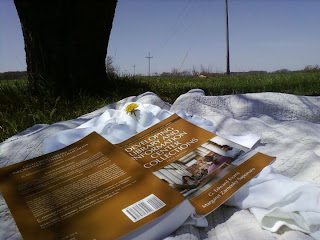 |
| Reading for LIS 7340: Collection Development |
Through my experiences and readings in Introduction to the Information Profession (LIS 6010) as well as Collection Development and Selection of Materials (LIS 7340), I felt compelled to develop a research proposal for the course Research in Library and Information Science (LIS 7996) which would focus on the topic of intellectual freedom and censorship. Being interested in small and rural libraries, selecting whom to study presented little challenge to me. Libraries that serve smaller populations, deemed Class 1 – 3 institutions, make up almost 60% of Michigan's public libraries yet in order to receive state aid they are not required to hire directors with a MLIS degree and out of the directors serving at these institutions only 23.7% actually hold professional credentials in librarianship (Library of Michigan, 2012). While conducting the literature review for my research proposal, I learned via studies conducted by Curry (1997) and Pooley (2008) that even directors holding professional credentials have identified themselves as having little or no training in dealing with censorship and intellectual freedom issues – yet the consequences of poorly handling a challenge could result in damaged relations with the community, termination of employment, and even the possibility of a lawsuit. While the ALA has set forth the Code of Ethics which seeks to give guidance on the topic of censorship and intellectual freedom, Fiske (1959) identified in her study that many selectors are actually practicing forms of self-censorship when making collection development decisions. Thus the goal of my proposed study sought to explore the state of collection development policies and practices as well as training pertaining to intellectual freedom and censorship in Class 1 – 3 public libraries in Michigan. My proposed study has the potential to provide the field of library and information science insight into developing training efforts to bridge any identified gaps in the knowledgebase and comfort level of its practitioners.
The eighth guiding principle of the ALA’s Code of Ethics states, “We strive for excellence in the profession by maintaining and enhancing our own knowledge and skills, by encouraging the professional development of co-workers, and by fostering the aspirations of potential members of the profession” (para. 5). By way of conducting library visits for Introduction to the Information Profession (LIS 6010), reference observations for Access to Information (LIS 6120), and additional visits for Survey and Analysis of Literature for Children Preschool to Grade 3 (LIS 6510), Young Adult Literature (LIS 6530), as well as Programming and Services for Children and Young Adults (LIS 7250), it became abundantly apparent to me that librarians in which I encountered truly support the notion of “fostering aspirations of potential members of the profession” (ALA, 2012). With each visit in which I conducted, several assignments required multiple observations, I was warmly welcomed by staff, invited behind-the-scenes, and not only left the building with a plethora of information, but felt completely inspired by my experiences. Thanks to these visits, I have developed professional relationships with several area library directors whom have acted as mentors throughout my MLIS candidacy.
 |
| Suzanne Todd |
The third and final learning outcome in which I have mastered proficiency in is, “[to] develop and apply current management and leadership theories and practices” (SLIS, 2012). I should start off by defining the difference between management and leadership: “The manager’s job is to plan, organize and coordinate. The leader’s job is to inspire and motivate” (
The Wall Street Journal). While I have learned immensely from all of my classes, I have a special appreciation for the courses that were taught by two adjunct instructors who were actively practicing librarianship in the field – Beth Walker (College for Creative Studies) and Suzanne Todd (Eastpointe Memorial Library). It was these instructors, regardless of the particular course being taken, who shared front line stories which provided more insight and reality than any carefully concocted case study that could likely be found in a management textbook.
One assignment in Library Administration and Management (LIS 7040) required the class to read an article, What’s My Motivation? (Rogers, 1976), that provided a scenario which is all too common in today’s libraries: budget cuts and staff lay-offs. In the case study, a very vocal staff member spoke up at a meeting and essentially asked the question, “What’s my motivation?” In her lecture, Walker provided an example in which an employee proclaimed that she, being Beth Walker (the supervisor), was responsible for motivating her. Walker’s reply was along the lines of, “She is not responsible for motivating the individual person, but for creating an environment that is conducive to motivation.” My own thoughts on the case study which touches upon both management and leadership techniques:
I felt as though the Library Director, Mary Lawless, was incredibly reactive rather than proactive during the transition process. While I understand that each person has their individual differences and personality which in turn gives different perspectives, Mosca’s reaction demonstrated that she did not understand the organization’s interim goal: the library operating rather than shutting off the lights and closing the doors. If Lawless had spent a little time laying some foundation work with her staff, such as clearly explaining the organization’s financial crunch, developing a game plan for the additional responsibilities, consistently employing recognition and positive reinforcement with her management-style, perhaps the Mosca-situation might not have occurred because the “unknown” would have already been answered. “Fear of the unknown” is how I chalk up Mosca’s behavior behind her interruption.
What is an LIS professional? What are the characteristics, qualities and knowledge that will be most important to you as an LIS professional? To answer the first question, I must cite Preer (2008), who in her book,
Library Ethics, cited Melvil Dewey:
The time was when a library was very like a museum, and the librarian was a mouser in musty books, and visitors looked with curious eyes at ancient tomes and manuscripts. The time is when the library is a school, and the librarian is in the highest sense a teacher, and the visitor is a reader among the books as a workman among his tools. Will any man deny to the high calling of such a librarianship the title of profession? (p. 9).
While the ALA Code of Ethics and the Library Bill of Rights are certainly a part of my philosophy, the five laws of library of science developed by Shiyali Ramamrita Ranganathan in 1931, also play a significant role in shaping my professional paradigm. The five laws are as follows: 1) Books are for use. 2) Books are for all. 3) Every book its reader. 4) Save the time of the reader. 5) The library is a growing organism (Haycock & Sheldon, 2008). In other words (and in the context of a modern public library and my own interpretation), the library and its many resources are for the public to use and the whole package needs to be easily accessible – the building, staff, and of course, the collection. The materials selected for the library should reflect the entire community in which the library is charged with serving – not just the frequent donor or the loquacious patron. Each reader has his/her own preferences and tastes; therefore, it is imperative that the library’s staff abstain from judging as well as be cognizant as to which formats are preferred by the community. In addition to having helpful, approachable, and knowledgeable library staff, saving the time of the reader also entails keeping the collection organized, easily accessible, and refreshed. And, finally, in order for the public library to survive, it must be viewed as a growing organism – changing and evolving to meet the needs of the community – otherwise it will become irrelevant and subsequently extinct.
Another statement which has profoundly affected my professional paradigm is one that I encountered while enrolled in Introduction to the Information Profession (LIS 6010). In her book,
Library Ethics, Preer (2008) quoted the esteemed Lester Asheim:
Selection, then, begins with a presumption in favor of liberty of thought; censorship, with a presumption in favor of thought control. Selection’s approach to the book is positive, seeking its values in the book as a book, and in the book as a whole. Censorship’s approach is negative, seeking vulnerable characteristics wherever they can be found – anywhere within the book, or even outside it. Selection seeks to protect the right of the reader to reader; censorship seeks to protect – not the right – but the reader from himself from the fancied effects of his reading. The selector has faith in the intelligence of the reader; the censor has faith only in his own (p. 79).

I am truly grateful for the professional relationships which have developed through the course of my studies. While I have aspirations of directing a rural public library and conducting research in the public library arena, I also feel compelled to give back to the field which has been both warm and welcoming to me as a new professional; therefore, I am very passionate about the notion of teaching as an adjunct instructor at Wayne State University as well as hosting practicum students in the future. In closing, as an information professional, I pledge to uphold both the Library Bill of Rights and the Code of Ethics as set forth by the American Library Association.
References
American Library Association. (2006). Code of Ethics. Retrieved from http://www.ala.org/advocacy/proethics/codeofethics/codeethics
American Library Association. (1996). Library Bill of Rights. Retrieved from
http://www.ala.org/advocacy/intfreedom/librarybill
Curry, A. (1997). The limits of tolerance: Censorship and intellectual freedom in public libraries. Lanham, MD: Scarecrow Press.
Fiske, M. (1959). Book selection and censorship: A study of school and public libraries in California. Berkeley, CA: University of California Press.
Haycock, K., Sheldon, B. (2008). The portable MLIS: Insights from the experts. Westport, CT:
Libraries Unlimited.
Library of Michigan. (2012). Michigan public library survey statistics. Retrieved from
http://www.michigan.gov/libraryofmichigan/0,2351,7-160-18668_61707---,00.html
Lingo, M. (2003). Forbidden fruit: The banning of the Grapes of Wrath in the Kern County Free
Library. Libraries & Culture, 38(4), 351-377.
Pooley, A., Birdi, B. (2008). How ethical are we? Public Library Journal, 23(1), 12-15.
Preer, J. (2008). Library ethics. Westport, CT: Libraries Unlimited.
Robbins, L.S. (1994, Fall). Anti-communism, racism, and censorship in the McCarthy era: The case of Ruth W. Brown and Bartlesville Public Library. Journal of Education for Library and Information Science, 35(4), 331-334.
Rogers, M. (1976). What’s my motivation? Library Journal, 134(10), 52-53.
Walker, B. (2011, April). What’s my motivation: Case study. Retrieved from http://blackboard.wayne.edu
Wall Street Journal. (2012). What is the difference between management and leadership?
Retrieved from http://guides.wsj.com/management/developing-a-leadership-style/what-is-the-difference-between-management-and-leadership
Wayne State University – School of Library and Information Science. (2012). Mission and goals.
Retrieved from http://slis.wayne.edu/about/mission.php


